Tuesday, 20 January 2009

Getting the shot


Its funny sometimes when you go shooting in a place that is loaded with interesting graphical elements and the shot of the batch that you choose to focus on is something that had nothing to with any of them.

My friend Sam, who you will find in the photograph above, and I went to such a place this past week. The Chemical Engineering "compound" on Tech's campus is filled with interesting forms, and the light around there is great at sunset. We decided to go check it out. I got some interesting photos out of it, but this one is my favorite. To me it captured what its like to be an amateur photographer. You're out there freezing your ass off trying to make yourself better at your favorite hobby. You click the shutter, check the LCD, study the histogram, sometimes wonder what the hell you were thinking, and then do it all over again. Its fun, but it can always be frustrating. I was lucky to catch Sam doing just this, and I hope that if you've ever taken a photo you can relate to this picture in some way a little deeper than "yeah I've done that before." You know what it feels like when you get that awesome picture that you can't wait to show your friends, right?

I have so many photographs to wade through. I've finally learned how to really properly post-process an image (read: I'm learning GIMP!!) and it takes me forever to get it where I want it. Its annoying and a revelation all at once. However, I'm pleased with how many photographs of mine so far that I start processing, and after some tinkering decide that I like them best untouched. Its reassuring in that it means I must be doing something right.

I still want a Holga.

Thursday, 15 January 2009

Monday, 12 January 2009

Trying for something real.


Something as seemingly trivial as getting a new camera has brought me to a profound realization: Approaching photography as a form of expression and not merely as a means of documenting an event or occasion is far more complicated than it may seem at first. When I first started getting to know my DSLR I was shooting for some, in my opinion, rather silly reasons. It seemed that I was on a mission to create glossy, glitzy, surreal looking shots that really carried little to no real meaning. Other than a "wow thats a cool picture," they were forgettable. I honestly went completely snap crazy my first week. I snagged any chance I could to use my shiny new toy. And while I produced some somewhat decent photographs, I'd have to say that any real thought they provoke on the part of the viewer is probably an accident.

Take this shot for instance:


I've gotten a lot of compliments on it (Thank you) but it says absolutely NOTHING. Well nothing except "Here's the Atlanta skyline." And thats it. I realized when I was processing this shot that I didn't want to just be constantly spouting shiny multi-colored night shots for people's desktops. I was suddenly totally bored with my picture. I put it on my flickr page simply because I felt it was part of my growth process, part of the journey, and technically I guess it wasn't half bad.

The point is that this shot has been done millions of times by millions of people, and certainly much better than I did it.

So my first baby step is that I've learned to look at my camera not as a toy, but as a tool. I didn't buy a DSLR to take "Awesome Pictures," I bought it to give myself total control over every aspect of every shot I take (something no point and shoot digital really offers)...And from there I will hopefully grow.

Additionally I've been soaking up anyone's work that I can, getting as much exposure to other people's pictures as possible. I feel thats important, because while having your own style is essential, having influences is what makes your style especially interesting, especially unique. I've noted that some of my favorite photographs, the ones that strike me the most, are not the glitzy, vividly colored ones, but the ones that are slightly overexposed, grainy, black and white....not what most people would call a "good picture." However, these pictures invariably make me feel something very definite, whether it be desolation, joy, or whether they just tilt your view of what makes a good photo for a split second. This makes every time I pick up my camera a total adventure.

In this vein, I've focused on the feeling that a photograph gives you, the viewer, and how I can bring that feeling in alignment with what I was thinking when I clicked the shutter. This is in contrast to the bright colors and Wow factor and aiming my camera at just "what looks cool." Its also narcissistic...but what artform isn't at least a little? *shrug* I'll allow it.

The photo I've posted along with this entry is hopefully a step in that direction. Its a photo that anybody could very easily take the same way I did with any old camera. Extreme sharpness and vivid color are not the point here. I deliberately used a higher ISO to make it a tad grainy and allow a faster shutter to make the lines and shapes as hard as possible. Beyond the technical details, I had my reasons behind the picture, but in keeping with the trend of trying to align the impressions of the viewer with my own intentions I'll let you draw your own conclusions.

Continuing further with this idea.... A small camera shop up the street from my apartment sells these little plastic cameras made by a company called Holga that cost about 20 bucks. They use their own proprietary type of film format, and have built in, fixed focal length lenses with simply horrible optics. They let in light through the cracks in the plastic body (usually a cardinal sin), and have manual shutters with no sort of onboard electronics at all. They don't even use batteries. And in the right hands they produce absolutely incredibly powerful photographs. The shop owner has a collection of incredibly valuable vintage 35mm and large format cameras in his own gear cache but he maintains that his Holga is one of his favorite pieces of gear. It encourages him to throw away all the rules and shoot "from the hip," which he says he can't bring himself to do on his vintage Nikon. These things have been heralded as the saviors of photography, which may very well be true.

From the Holga Website:

"The unassuming Holga is here to save you from a future of digital pixels and images shared on small screens on cameras or phones. We have all become numbed with photography, there is no denying it, but a chunky camera made almost entirely of plastic has been put on this Earth to save us. It will reawaken your vision, fill you with joy, make you see beauty when you thought it had disappeared forever, and bring out sunshine on a cloudy day."

Holga Website

So did I buy a 500 dollar camera to take a bunch of low res, washed out pictures? No. But its nice to have to option. :)

Saturday, 3 January 2009

Picking up where I left off.


So its been a long time since I've posted. Film and processing had gotten very expensive for me after I got home from Europe. So I decided to simply save the money on film and buy a DSLR eventually. So thats what I did. I'm now the owner of a Nikon D40. It came with a fairly decent 18-55mm kit lens, so thats what most of these will be taken with.

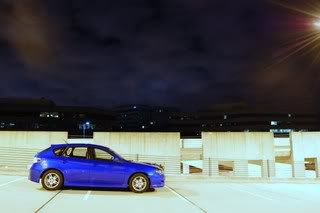
My favorite subject lately is my car. Its not terribly deep, I know, but its a good subject to compose a photograph around. This was taken atop a nearby parking garage around midnight.


There's lots of noise in the clouds, but for a single exposure I think the outcome was rather good. Its been tweaked a little. I had to cool down the colors a little. The original exposure had a too much red tint to it. I chalk that up the overhead lights.

More to come. :)

Saturday, 11 August 2007

So...


Remember what I said about focusing on form?

Wednesday, 11 July 2007


Godstow Abbey, 8 July, 2007.


So I spent this past Sunday afternoon and evening at the Godstow Abbey on Port Meadow, about a 45 minute walk from Oxford's city centre. A couple days later, when I managed to get the resulting roll of film developed, I was pleasantly surprised to find that this made it through a nasty case of shutter stickiness, which caused almost 22 exposures out of 36 to come out completely blank. Somehow, and thankfully, I managed to get this one. The sticky shutter has since been remedied (I believe, it's still a tad temperamental), but I learned something important from this particular photograph. Its somewhat of a milestone for me. Point, line, shape, form, texture, pattern, and color are all much more present than any of my other efforts, I think. The shapes of the ruins of the chapel and the abbey wall are all relatively balanced, and the colors are richer than I've managed in the past. The exposure is decently executed, and lo and behold I retained definition in the sky, the stone, and the grass, with one exposure.

Nevertheless, this was still sort of a happy accident, and of course I can do much better. Even so I began to look at what drew my eye to this particular scene so that I may better understand my photographic self. I think ultimately this was a convenient natural occurence of the rule of thirds, for one. Standing and simply looking at this structure, it's quite imposing, but still seems devoid of anything that'll make a great photograph. When you look at it through the viewfinder, things change though, as is so often the case. I seem to have focused on shape here more than anything else, hoping that the exposure would simply be a vehicle for the forms. However, (because I bracketed!! WOO!!) I managed to come out with an exposure that was somewhat of an enhancement, and the colors kind of popped when I first saw it. However, I think that if any merit can be drawn from this shot, it's that it shows a small amount of emerging competency in composition. Exposure is a technical aspect that can be learned, while composition has proved much, much more elusive to me. While this is a good start, I still have quite a long way to go, so I must take what I've learned with me the next time I go shooting in such a way.

Since seeing this photograph, I've developed a fascination with form, and I did about an hour-long shoot around Worcester today. I spent the time trying to pick out any repetition of form, or complimentary shapes that exist in objects I walk past every single day. Doorways, benches, trees, pictures on the wall, classrooms, anything, really. I payed less attention to color, as well, so as to hopefully place the focus solely on my composition. Hopefully this'll help me find my falterings and my emerging strengths. I'll have the prints back tomorrow, so we'll see.

I've also found that I like shooting in harsh light. The print at the top of this post was shot around 3 or 4 in the afternoon, and the sun is still very high in the sky here in Oxford, so shadows are very pronounced, and photos can be far too contrasty if you're shooting facing the sun. Interesting, I suppose. I shall take it farther, hopefully.

In any case, cheers.

Russ

Monday, 9 July 2007

Pointlineshapeformtexturepatterncolorasaurus...

I realized something today when I was walking around running errands; I have what I will refer to as the "that looks cool so I'll take a picture of it" disease.

I need to start looking at photographs in a much different light (hehe, no pun intended) than I have in the past. I've always had the idea that if anything strikes me as interesting looking, it'll make a good photograph. This is completely and utterly false, in my limited experience. Nine out of ten instances the image in question is too busy, says nothing significant, or is impossible to accurately represent photographically without post techniques I have zero access to (or, let's be honest, ability to use) at the moment. I came to this conclusion after realizing first that I'm not really a tourist anymore, as I sort of live here in Oxford on a bit more of a long term basis than any of the other places I've been in the past month and a half, so I don't need to take the "Holy shit the (famous place here)" photos anymore. And, at least to some to some degree, the sick amount of pictures I've taken with my camera already have shown me it's capabilities, which I'm proud to say are quite impressive for an entry level camera that's almost 20 years old. So, with that basic foundation in place, I can begin to focus my attention much more on composition, which is a relief, as my pictures have been somewhat generic to this point. Granted, I've gotten some technically good shots, but for the most part they're uninteresting, and aside from being somewhat aesthetically pleasing, if someone were to ask me what prompted me to take it, I'd have nothing beyond "Well....I liked the way it looked," and that's not why you take photos...at least on a level beyond "Look, I was there."

I simply wish I knew how to make my pictures say something. I mean, granted, I've been tossing this age-old question around in my head for a mere 5 weeks. A lot of people spend years doing so. But, it seems there's much more to it than simply snapping a shot of a pretty pink sunset, or taking pictures of ducks and boats. I've found that my simplest shots of the seemingly most mundane things have been my favorites, because when you do that, you're pulling artistic value out of the completely ordinary. For example, I have sitting next to me a close shot of part of my windowsill in my room, and it, to me, holds much more significance than the shot right underneath it in the stack of a very, very beautiful sunset we had a week ago. I (somehow) managed to make something completely ordinary, even flat out unappealing, into something someone might look twice at. However, this is nearly all I have to show from 6 rolls of film.

To this end, I believe that shooting in black and white for a little while will do me good as a photographer. The absence of the rich colors usually present on modern films forces the photographer, and ultimately the viewer to focus on the basics; point, line, shape, form, texture, and pattern. Color is usually the last one, yes, but the point here is the absence of color. Once I have the basic tools down, I think bringing color back in will make my photos much more worth looking at, as right now I'm drawn to bright colors (like most primitive creatures), rather than things that lead an observer around a picture...like on a little mini-journey of epically esoteric proportions.

Now I just need to purchase a black and white film that a minilab over here can do something about processing.

Russ